AI in ESL “Who” “What” “When” “Where” and “Why”

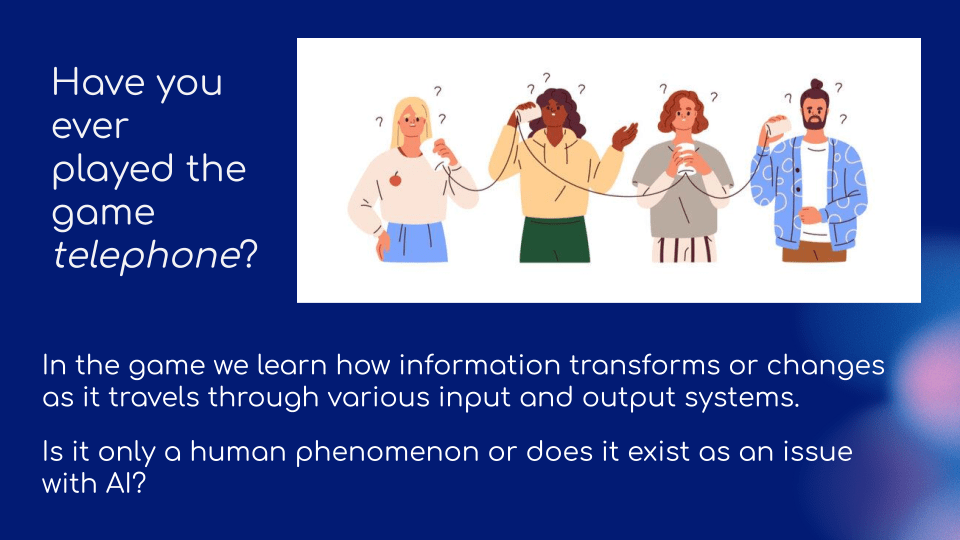
Have you ever played the game called “telephone” ? If you have not you really should. If you are in one of my classes you surely will play it! To start to play, the teacher tells person A a sentence, person A then tells person B the same sentence, and so on. By the time we reach person D – Z the sentence that was first told can be morphed into a completely different sentence entirely! It is a game that depicts what happens when, as the saying goes, “you get your wires crossed.” Basically, there is a breakdown in communication somewhere and no one has any idea why. Usually at the end of the game people laugh because the sentence is so radically different. Sometimes people from the circle share that it had been completely different at the middle of the chain from both the beginning and the ending sentence! What we learn from this activity is how information changes as it travels through various input and output systems. In the game “the systems” of transmission are human beings.
Looking at factors that affect SLA acquisition from a DST approach (Dynamic Systems Theory), Karim Sadeghi states in their book Talking About Second Language Acquisitions that one can deduce that intrinsic as well as extrinsic variables affect the understanding of language and the interlanguage processes. The variables are intelligence/memory levels (aptitude for deciphering linguistic patterns), motivational constructs and attitude, the dynamics for an individual between an L1 and an L2, and the environment and input that was actually received whilst trying to acquire the information.
If we think in the context of the game telephone, Sadhegi’s assertion that “it is the input that plays (in combination with other factors) the most influential part in the success of second language acquisition, in that without the input, L2 acquisition cannot even start.” depicts that without the teacher or “student a” and etc. to carry on the message, nothing at all would be said is true. The conceptualization one realizes in connection to SLA and AI is that the initial communication must start somewhere or come from somewhere in order for an interaction and output to then take place.
The AI (generative) system of transmission is a computational device but it in many ways replicates the way that the brain stores and recalls information. We must also remember it has been designed by human beings and has received all input of information and directions from human beings. AI is a tool that is designed to take the best of all the knowledge of humanity and place it together into an equation that when solved results in an answer with such a high efficacy and ingenuity that it surpasses the capacity of human intelligence.
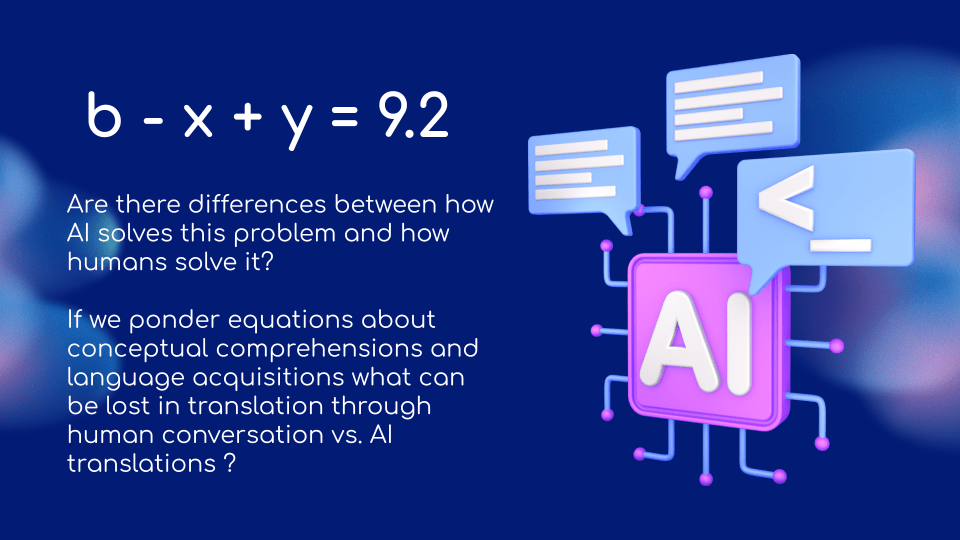
b – x + y = 9.2
When given a problem like the one shown above AI will diligently and efficiently work to find the answer. The issue arises when the answer is not a possibility (either because it is impossible, or it just hasn’t been imagined yet) or when there are multiple ways to answer a question (and this is where AI often malfunctions. How could it have any idea to correct itself? Why would it want to? And how do humans realize when AI has a mistake?)
Sadeghi also states that “to trigger language acquisition input itself is not enough to gauge learning to materialize and there is a need for interaction” between human beings in an environment. If we consider processes of AI generation then the same is also true for computing conceptualizations, which means that negotiations must take place in the classroom between the uses of AI and the necessary active effort during learning processes of humans.
AI in ESL “Who” “What” “When” “Where” and “Why”
For the purposes of constructing this philosophy about AI usage during SLA instruction I will discuss the ways in which AI is useful and the ways that its usage is problematic. To answer the question about “who” is using AI, the answer is simply that everyone is using AI to some extent in their daily lives.
In an academic and educational context we can define “what” AI is with discourse discerning generative and discriminative AI. Priten Shah in his book AI and The Future of Education: Teaching in The Age of Artificial Intelligence defines discriminative AI models as those that “classify and differentiate data” in order to decipher the “differences between categories of data.” Shah defines generative AI models, which he states appeared after 2022, as models that utilize “unsupervised learning” (which means that it uses algorithms to find patterns or structures, while supervised models utilize algorithms of labeled data) which prompts the generative AI model to “create new content or outputs based on the input that it receives and its learned understanding of the data provided to its models.”
The recent shift from AI models that mainly categorized and classified data to technologies that utilize that data to generate conclusions and answers with a prescribed algorithm thinking process (about which data to grab and where to expand or detract on a subject) depicts that AI can definitely provide humans different perspectives and coherent perceptions about data.
However, utilizing AI data, without monitoring what its output was, is highly problematic. And this is where I believe the issue of academics and education become involved. It is imperative to check AI’s “work” seemingly as if you are a teacher. But how do students, and Second Language Learners, have the ability to correct small or big mistakes that AI has made if they have not yet finished their education (or gathering of a knowledge base and foundation of thought) ?
An example of issues when utilizing AI to derive definitions and conceptualizations is a recent search that I did about what the word “sprezzatura” means. AI defined it as a flippant clothing style that reflects a laissez-faire attitude, and that was all that was said. However, in academic studies we learn that it is the result of a movement of substantial change of agency and mobility, which arrived after enormous financial, social, political, educational and theological developments in civilization resulting in new eras such as the Renaissance in which humanity expanded its capacity for knowledge and progression of all kinds. Sprezzatura is the result of social and mobility becoming a possibility and changes in strict rules of classism. It marks a change from peasantry systems to the development of resumes. It is true that the extreme changes across all facets of civilization did lead to changes in clothing styles and attitudes about oneself and others (confidence.) There are enormous amounts of important comprehensible data lost in the derived answer provided by AI. AI was succinct and barely correct with its output in that instance.
Of course, there are many wonderful aspects of AI that can enhance humanity and education. A teacher has to know “when” and how to utilize the technology to its potential. In a course about ways to enhance projects for English students we uncovered a lot of research about the use of sound applications for students with disabilities. There was a disabled student in the class that educated us about many ways that voice commands can supplement written or typed work (which he was unable to do.) The activities that we discovered were so fun and enhanced our educational portfolio substantially for speaking and listening skills related to comprehension and projects. We soon wondered, why isn’t everyone doing this? These types of tools do not fall into the “generative” AI category for the purposes of this paper and all such devices that enhance accessibility I believe should be made available to all students as immediately as possible.
Priten Shah provides many examples of helpful usages of AI such as the global connections that can be formed, language translation, cultural insights that may be gleaned, project-based learning that is supported by technological advances and an inclusive design that can provide adaptive services to make learning experiences accessible to all. These types of tools for formatting in AI should also be employed as immediately as possible in the classroom or learning environment.
The last part of this paper is discourse about utilizing AI in academia specifically for students learning a second language because AI offers many and various models that can enhance our studies and learner acquisitions. Specifically where AI is utilized in SLA is difficult to encapsulate succinctly so I am going to discuss a few examples in depth.
“The Effects of Captioning Videos Used for Foreign Language Listening Activities” by Paula Winke, Susan Gass, and Tetyana Sydoreaka is a research study performed through Michigan State University. The concept of the study is to find out the efficacies of SLA learners’ experience when watching captions while experiencing foreign videos. The study implemented three documentary videos and vocabulary tests that focused on target language within the videos, along with comprehension questions and survey questions about perspectives of the video captioning experience.
The findings of the study depicted that learners do have a need for numerous input modals and methods, the captions of the videos did reinforce the input that was received visually and orally, and the captions were able to keep students engaged with the material. Further discoveries were that students that were shown the videos with captioning only the first time were better able to acquire the vocabulary than students that watched the video with captions only the second time.
The results of the effects of captioned videos performed by Winke, Gass, and Sydoreaka showed that learners must have some interaction with the videos, such as captioning, in order to bridge the gap of understanding and that the interaction should happen as immediately as possible before the learner categorizes data as simply “unknown.” The study certainly dictates that the “when” of AI is to implement it immediately if possible.
Sadeghi insists that “enough exposure to natural language and comprehensible input [is] sufficient.” and in the study about captioning on videos we discover that the written translation simultaneously with the natural depiction greatly enhances, or speeds up, acquisition. It also happily interferes in the interlanguage moment of learning when a student is intentionally focused on comprehension. Lightbown and Spada (2013) in their analysis “How languages are Learned” quote Larry Sinkler’s (1972) study states that interlanguage analysis depict “it has some characteristics influenced by previously learned languages, some characteristics of the first language, and some characteristics, such as the omission of function words and grammatical morphemes, that seem to be general and occur in all interlanguage systems.” An understanding of interlanguage processes and exposures to language allows us to conceptualize that providing data in multiple formats at once, such as sound, visual, writing, speaking, and other forms of communication assists acquisition of a second language.
If one considers theories such as The Critical Period Hypothesis as discussed by Ioup, G., Boustagui, E., El Tigi, M., & Moselle, M. (1994) in “Reexamining the critical period hypothesis: A case study of successful adult SLA in a naturalistic environment.” in which focuses on data about a child-like and natural acquisition of absorbing linguistic data in which it is proposed that children have a magical developmental era in which learning and acquisition is generally manifested without effort one must consider the amount of data that they are exposed to. It is a substantial amount of speaking, listening, written input, and interactions that they rely on, to communicate about all the necessities of life, including how they feel. One can imagine for a child it’s almost like an emergency situation and they are looking at anything and everything they can to create a conceptualization and use interlanguage to formulate a way in which to express it. The phenomenon need not only pertain to the CPH child period in my opinion. There is an opportunity to be inundated with data of all kinds and to generate excitement for learning and acquisitional scenarios through intentional lessons that simulate CPH which AI is able to assist with by providing many forms and modes of data output.
Where is AI currently being used by SLA students? A study that is about Sound Applications called “English Phonology: Student’s Perception Toward English Sound Application To the Learning of Pronunciation”, pertaining to the English Sound Application in particular, by Claire Febian, Fasikhatul Mabrurah, Fenesia Affara, Lasillinda, Hindun Nazulfa, and Tri Agustiningsih, shows that students in non-Roman alphabetic languages reported that the app enhanced their classroom instruction across all areas of comprehension and phonology. Particularly in phonetics they received feedback from the app about pronunciation, intonation, stress and sound. The tools that are used in the app such as phonetic transcriptions, symbols and sounds appealed greatly to a generation that was very technologically inclined. The study consistently indicated that students are enormously preoccupied with pronunciation skills and practice that the most in their free-time outside of class when they wish to enhance their acquisition of the English language. The students also reported having better comprehension skills when they correctly learned and heard the pronunciation of vocabulary.
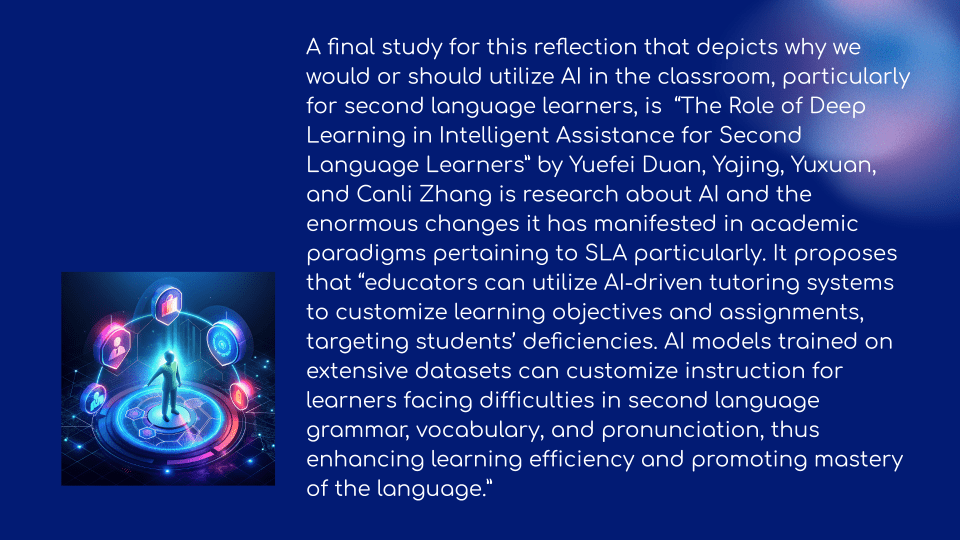
A final study for this reflection that depicts why we would or should utilize AI in the classroom, particularly for second language learners, is “The Role of Deep Learning in Intelligent Assistance for Second Language Learners” by Yuefei Duan, Yajing, Yuxuan, and Canli Zhang is research about AI and the enormous changes it has manifested in academic paradigms pertaining to SLA particularly. It proposes that “educators can utilize AI-driven tutoring systems to customize learning objectives and assignments, targeting students’ deficiencies. AI models trained on extensive datasets can customize instruction for learners facing difficulties in second language grammar, vocabulary, and pronunciation, thus enhancing learning efficiency and promoting mastery of the language.”
Students in the group that utilized AI in the classroom exhibited more participation which was measured by observing the times students spent raising their hand and time they spent in contemplation solitarily. “Participants observed heightened motivation, autonomy, and linguistic precision” as well as better academic performance when AI was integrated into the classroom entirely. This study depicts that AI doesn’t cause learners to become isolated but enhances WTC (willingness to communicate) which seems to be the added bit of confidence derived by students feeling that they have something relevant to contribute to the discourse which in turn propels their participation and enhances overall knowledge efficacy. Willingness to communicate is the “why” of using AI.
Su-Ja Kang (2005) extrapolates in “Dynamic emergence of situational willingness to communicate in a second language” that certain situational factors greatly affect a student or learners willingness and actions of engagement with the learning and acquisition process. Kang’s study conducted research on students that were interviewed during different moments of development and situations in a university class and tutoring center as they developed their second language acquisitions. Many factors influence a students participation and learning but some notable variables are the “Influence of conversational context on excitement” which depicted students becoming more eager and motivated to participate if they were asked for additional information while talking.
I have witnessed this for myself as a teacher of English classes in relation to AI. Students are eager to search for context, pronunciation of a foreign word, or a date or name that may be in context to the material and which we have a question about. I encourage these sessions of distraction or further research as “brain breaks” and also as a way of knowledge seeking I wish to impart on my students. It’s like looking for a footnote or a fact on the side of the page that is not there and we can go and find it. Tangents in the middle of a class conversation serve many purposes and actually serve to keep students engaged and the lessons relevant or fun, and students are uplifted about conceptual and contextual research and proudly return to the class with the information.
The process is also exciting enough as a method of research (ponder, search, suppose, and find) that the entire process is memorable and everyone enjoys an academic bonding as we learn something new together. There is nothing like it! The saying “No one can take your education away from you” is true and when one learns something extra that they like, or have always been curious about, they feel that ah-ha moment and jubilation. Forever after, the learner now has the answer to that once elusive concept. These are the moments we treasure as teachers. Generative and Defining AI can and does assist with learning and acquisitions and I am grateful that we have it to use on our educational journeys.
My AI teaching philosophy pertaining to academia and for methodologies of teaching purposes and learner engagement for SLA is to incorporate AI in as many facets as possible as often as possible and to incorporate the tools AI provides with immediacy whenever possible. Utilizing AI garners more student engagement and accessibility which enhances comprehension and learning
A balanced approach is the consideration that learners require confidence and ability to perform when they are removed from situations where AI is accessible. For those instances of needing foundational skills and bases of knowledge in order to build upon such constructs for future comprehension and conversations it is of course a top priority to both students and teachers that learners practice and actively engage so that they can produce their skills and knowledge without the AI once the AI scaffolding is removed.
Bibliography
Duan, Y., Zhang, Y., Li, Y., & Zhang, C. (2025). The Role of Deep Learning in Intelligent Assistance for Second Language Learners. International Journal of Education and Humanities, 19(2), 1–8. https://doi.org/10.54097/snmqay54
Febian, C., Mabrurah, F., Affara, F., Nazulfa, L., & Agustiningsih, T. (2022, June). English phonology: Student’s perception toward English sound application to the learning of pronunciation. In Conference on English Language Teaching. https://doi. org/10.24090/celti. v2 (Vol. 52).
Kang, S. J. (2005). Dynamic emergence of situational willingness to communicate in a second language. System, 33(2), 277-292.
Ioup, G., Boustagui, E., El Tigi, M., & Moselle, M. (1994). Reexamining the critical period hypothesis: A case study of successful adult SLA in a naturalistic environment. Studies in second language acquisition, 16(1), 73-98.
Sadeghi, K. (2022). SLA at 55: What Are the Key Issues? In Talking About Second Language Acquisition (pp. 1–19). Springer International Publishing AG. https://doi.org/10.1007/978-3-030-99758-8_1
Shah, P. (2023). AI and the Future of Education: Teaching in the Age of Artificial Intelligence. John Wiley & Sons.
Winke, P., Gass, S., & Sydorenko, T. (2010). The effects of captioning videos used for foreign language listening activities.